For two decades the story of padel court construction was a European story. Spain, Sweden, Italy and France absorbed nearly everything the industry built. That era is now officially over. When the International Padel Federation presented its third World Padel Report to the General Assembly in Madrid on 12 October 2026, the headline was not a record total — although the record was broken too. The headline was geography: for the first time, Asia has become the continent with the most new padel clubs, taking 39.0% of global openings against Europe's 37.1%.
The shift is dramatic when set against the previous survey. In that earlier report Europe still accounted for 54.7% of new clubs and Asia just 25.1%. Within roughly a year the positions have effectively reversed, and Asia's share of new courts installed worldwide has jumped from 10.0% to 31.7%. For court manufacturers, suppliers and investors — including international padel court solution brands such as akeepo — this is the most significant change in the market's structure since the sport went global.
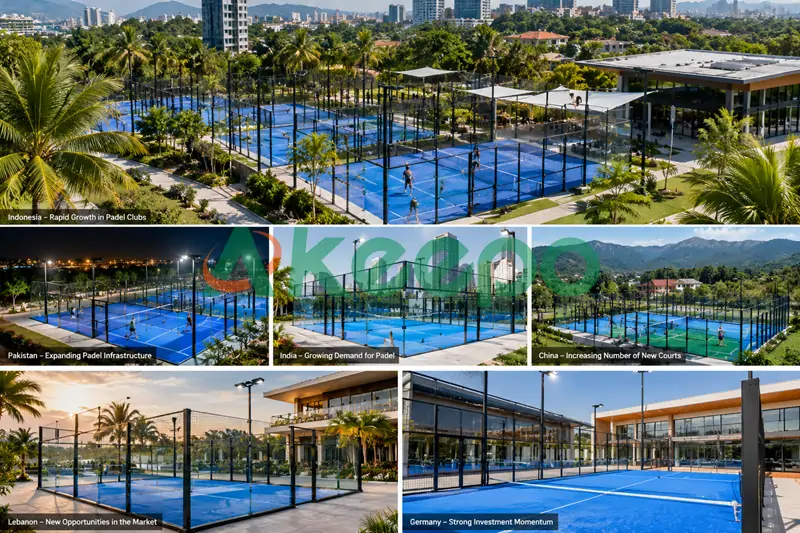
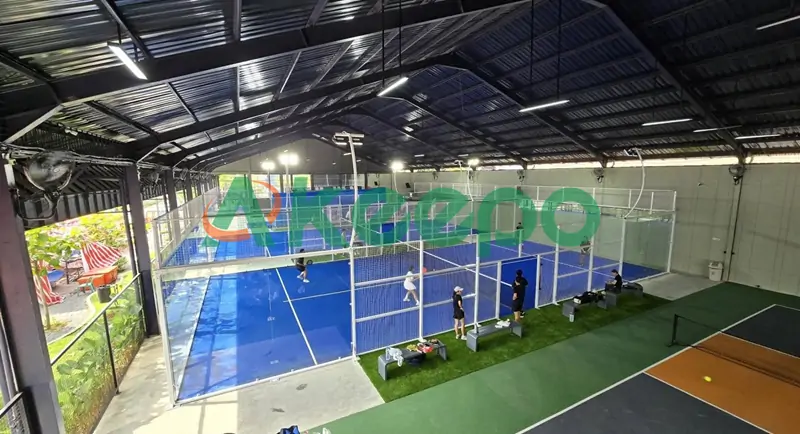
Aerial view of new padel courts in a tropical Asian city — the region now takes 39% of all new club openings worldwide. (Reference image: akeepo padel court projects)
The raw totals behind the headlines: the FIP infrastructure survey now counts 91,234 courts across 28,497 clubs and facilities, up from 77,355 courts and 24,634 facilities in the previous edition — an increase of 13,879 courts (+17.9%) in about ten months. Padel is now played in 191 countries and territories, and 59 of them have more than 100 courts, up from 47.
1. What the 2026 numbers actually say
Three findings matter most for anyone planning a padel investment this year.
· The growth engine has moved, but Europe still leads in volume. Europe accounts for 42.4% of new courts installed, down sharply from 59.2%. Asia's 31.7% share means roughly one in three new courts built anywhere in the world is now built in Asia.
· New clubs are bigger than the installed base. The average new club opens with 3.6 courts worldwide and 4.1 in Europe, against an installed average of 3.2. Investors are not testing the water with single courts; they are building proper multi-court venues from day one.
· Court time remains the business. Court rental generates €4.60 billion of the modelled €6.8 billion in global padel spending — 67.2% of every euro in the sport. Any court project still stands or falls on utilisation, whichever continent it sits on.
2. Indonesia: the case study the whole industry will cite
If one market defines this report, it is Indonesia. The FIP lists more than 750 additional clubs and around 2,534 additional courts recorded there since the last survey — an estimated annual growth rate of 440.8% in courts, the fastest of any major market. Several hundred more facilities are under construction.
And the demand is real, not speculative. Google searches related to padel in Indonesia have grown by roughly 200%, and Indonesia has become the third-largest source of traffic to the FIP website, behind only Spain and Argentina. International tournaments held in the country now draw entry fields deep enough to require as many as four qualifying rounds. Jakarta alone has added covered, floodlit multi-court venues that open at 06:00 and stay booked through the evening — the signature pattern of a market where supply is still chasing demand.
3. The rest of the table: Pakistan, India, China — and one European surprise
Indonesia is the outlier, not the whole story. The FIP's table of accelerating Asian markets reads:
· Pakistan: 104 new clubs, 340 new courts, estimated growth +283.3%
· India: 90 new clubs, 290 new courts, estimated growth +148.7%
· China: 100 new clubs, 233 new courts, estimated growth +143.2%
· Lebanon: 76 new clubs, 154 new courts, estimated growth +130.8%
Meanwhile, the loudest European surprise is Germany. The report puts German on-site construction spend at €79 million — the highest in the world — and projects 111.5% court growth for 2026, the steepest curve among Europe's established markets. The lesson is not "Europe is shrinking." It is that a country with money, land and late adoption can compound very quickly, and Asia simply has more of those countries right now.
4. Why this matters for court buyers in emerging markets
A boom at this speed creates a specific kind of risk: buyers who have never built a court before, ordering from suppliers they have never met, on timelines that reward whoever ships fastest. The report's own data shows why the structure of the deal matters more in Jakarta or Lahore than it did in Madrid a decade ago — there is no installed base of experienced contractors, spares and service teams to absorb mistakes.
Five things separate a court that is still bookable in five years from one that becomes a maintenance line:
· Engineered structure, not a render. Wind-load certification, glass thickness and tempering standard, steel section schedule — documented, not implied. Tropical and coastal sites in particular need marine-grade fixings and cyclone-rated frames.
· Climate-correct surface. Low-infill or infill-free turf and proper drainage keep a court open through monsoon seasons, which is exactly when covered courts earn their premium.
· Complete delivery scope. Container packing, lead time, installation supervision and drawings the local contractor can build against. A supplier who only quotes square metres hands all integration risk to a first-time operator.
· Serviceability. Replaceable glass panels, accessible fixings and spare parts that remain available in year five — the question most buyers forget to ask.
· A realistic revenue model. With court rental worth 67.2% of global spend, the facility lives or dies on bookable hours, not on F&B or merchandise. Price the court hour, count the hours, then size the build.
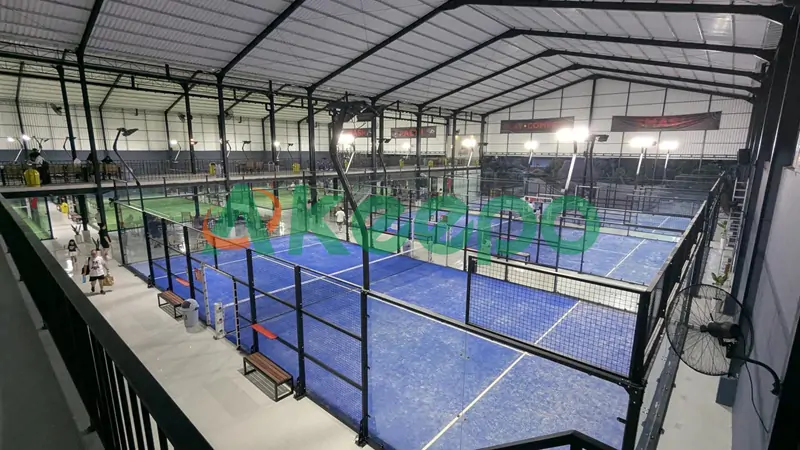 This is the model akeepo works to for club and resort clients: full panoramic, classic framed and covered tent courts, with glass, turf and lighting specified as one documented system rather than a shopping list.
5. Three questions before joining the boom
1. Where exactly is my market's utilisation today — and is the new club next door opening three courts or thirty?
2. Is my supplier's structure certified for my actual wind zone, and can they name the fixing and panel specifications in writing?
3. Who repairs the court in month thirty, and how much does one broken glass panel cost delivered to my site?
Bottom line
The FIP World Padel Report 2026 marks the moment padel's construction map stopped being European by default. Asia now opens more new clubs than any other continent, Indonesia is compounding at rates no market has matched, and Germany proves late adopters can still grow explosively. But the report's quietest number is the most useful one: two thirds of all money in the sport is court rental. Whether the next court is built in Jakarta, Karachi, Shenzhen or Munich, the winning projects will be the ones specified, delivered and serviced as complete systems — before the first container is booked.
Back to News Start Your ProjectRecommended Products